The Gulf monarchies have always shared a strange paradox — ancient traditions wrapped around cutting-edge modernity. But this new generation of leaders isn’t content with only being rich. They want to be relevant. They want their countries to matter in a post-oil world — to host the world’s conferences, dominate global finance, and maybe even colonize Mars. That’s the spirit behind a trilogy of grand national visions: Saudi Vision 2030, Qatar National Vision 2030, and the UAE’s “We the UAE 2031.” Each one is a roadmap to survive the end of the oil age. But each leader is approaching it differently — like three rival CEOs in the same industry trying to sell different versions of the same dream….
Blog
-
Who are Russia’s silent partners in the Middle East post-2022?
The other day, I was listening to Russia scholar Mark Galeotti’s podcast, In Moscow’s Shadows, and Galeotti made a comment about “Russia’s silent partners in the Middle East.” He mentioned Israel, Saudi Arabia, and the UAE specifically. For context, the topic of the episode was the impact of the Israel-Iran War on Russia. After February of 2022, Russia has been upgrading its ties with the GCC states. The UAE allows sanctioned Russian businesses to operate there. Saudi Arabia and Russia have been cooperating on oil prices, and Russian warships have even been spotted making port calls in Saudi Arabia. Jerusalem, for its part, has maintained a somewhat cordial relationship with Russia in spite of October 7th and Putin’s hosting of a Hamas delegation in Moscow. It is Russia’s relationships with these countries that have more room for growth and evolution, compared to traditional Russian partners like Iran and Syria. Galeotti even made the argument that Iran is becoming increasingly less important to Moscow. In this post, I want to answer the following questions: How have Moscow’s ties with Jerusalem, Riyadh, and Abu Dhabi transformed post-2022, and how will they develop going forward?”
Russia-Israel relations after 2022
The relationship between Jerusalem and Moscow has been one that has oscillated between warmth and outright hostility. After 1991, Russia’s relationship with Israel started to blossom into a proper partnership. Russian and Israeli heads of state would visit each other’s countries throughout the 2000s. The War on Terror would facilitate ties between the two as they both had their own radical Islamist threat to contend with. At this time, Putin was still making attempts to build bridges with the West.
Of course, it would be remiss not to mention the people-to-people ties between Israel and Russia. Following the Soviet Union’s collapse in December 1991, a wave of over a million Soviet-Jewish olim arrived in Israel. Israel has the third-largest Russian-speaking diaspora outside of the former Soviet Union. This diaspora maintained significant cultural and business ties to Russia. Several leading Israeli business conglomerates had strong ties to Russia prior to October 2023. Russian-speaking Israelis are heavily represented in the Israeli tech sector (one of the primary drivers of the country’s economy). Russia and Israel even signed a military cooperation agreement in 2010.
Russo-Israeli relations after 2022 are of particular importance to us. After the Russian invasion of Ukraine in February, Israel did not (and still has not) place economic sanctions on Russia. In fact, Israel still allows flights to and from Russia. As far as Ukraine is concerned, Jerusalem has still not provided Ukraine with lethal aid. Russia, meanwhile, has dialed back its military support for Iran and turned a blind eye to Israeli airstrikes on Iranian targets within Syrian territory. Complicating this arrangement and creating the need for further dialogue is the presence of Russian military bases in Syria.
While Russia is opposed to American and Western intervention in the region, Moscow and Tehran are not marching perfectly in lockstep with each other. Russia is not very enthused about Tehran gaining access to nuclear weapons. Generally, nuclear-armed states do not want other states to acquire nukes. Even more importantly, Russia does not have the means or the desire to throw down with Israel or the U.S. over Iran. The Russians are far too overextended in Ukraine to commit manpower and resources to the Middle East.
However, the wars in Ukraine and Gaza have marred relations between Israel and Russia. In response to Hamas’ attack on October 7th, 2023, Vladimir Putin described the attacks as “a clear example of the failure of US policy in the Middle East.” He also compared the Israeli blockade of Gaza to the Siege of Leningrad. Also in October of 2023, Putin hosted a Hamas delegation in Moscow at a meeting attended by Iran’s deputy foreign minister. Despite this, Moscow stood by as Iran was pounded by Israeli and American aircraft. Moscow has also not downgraded its relations with Jerusalem or done anything beyond symbolic condemnations.
To echo Mark Galeotti’s argument, Iran is becoming less important to Russia. Moscow once relied on Tehran’s supply of drones (like the Shahed 136 and others) and other military equipment. At present, however, the Russians have significantly ramped up their domestic drone production. Additionally, China (not Iran) supplies most of the spare parts and technological components required to assemble and maintain Russian weaponry. Tehran needs Moscow more than Moscow needs Tehran. Two of Iran’s geopolitical rivals, Saudi Arabia and the UAE, have upgraded their relations with Russia since 2022. Allow me to analyze and contextualize Russia’s relationships with Abu Dhabi and Riyadh.
Moscow and Abu Dhabi’s partnership
Russia has had a hand in the Emirati defense industry for some time. Emirati defense firms have worked in conjunction with companies like the Russian car brand GAZ and defense contractor VR Technologies. The UAE’s military has also purchased Russian equipment, like BMP infantry fighting vehicles. As a matter of fact, the UAE is Russia’s largest trading partner in the Middle East. Trade between Russia and the UAE totaled roughly $10 billion in 2024. After February 2022, relations with Abu Dhabi became a bigger priority for Russian policymakers. In 2021, trade between the two countries amounted to $4.6 billion and ballooned to more than $8 billion in 2022.
Tourism is another component of Russo-Emirati relations. In 2018, 1 million Russians spent over $1 billion in the UAE. After 2022, many Russian businesses moved their operations to the Emirates. On June 1st, 2018, Moscow and Abu Dhabi signed a “Declaration of Strategic Partnership” which called for cooperation in several key areas, including politics, security, and economics. The UAE expressed interest in jointly developing a fifth-generation fighter with Russian firm Rostec. However, numerous challenges have thrown a wrench in the project.
Abu Dhabi and Moscow have invested in each other’s petrochemical sectors as well. In 2021, Mubadala Investment Company purchased a 1.9% stake in Sibur, Russia’s largest integrated petrochemicals company. Since 2010, Mubadala has invested more than $3 billion in the Russian economy. Diplomacy is another key area of cooperation for the UAE and Russia. It must be noted that the Emiratis abstained from a UN vote condemning Russia’s invasion of Ukraine. Like Israel, the UAE has also not imposed economic sanctions on the Russians. A former professor at Abu Dhabi’s National Defense College said the following about Moscow’s relationship with the Emiratis: “The UAE sees Russia as a very reliable partner as opposed to western countries who have to defer to parliaments and civil society pressure.” In other words, Russia is willing to work with the Emiratis without giving grandiose lectures about human rights or worrying about pressure from constituents and lobbyists. As both countries have expanded their footprint in places like the Red Sea, there will be a greater basis for cooperation between the two.
Saudi Arabia’s cooperation with Russia
Russia and Saudi Arabia share many similarities. Both are authoritarian rentier states that are oil superpowers. Both countries’ actions against dissidents have soured their relations with the United States and the West in general. In fact, Saudi Arabia and Russia have cooperated with each other in the past. In 1926, the USSR was the first country to recognize the Kingdom of Hijaz and Nejd (as Saudi Arabia was called before 1932). Just before the collapse of the Soviet Union, Saudi Arabia and other GCC countries furnished billions in aid money to Moscow. Still, it must be mentioned that these were brief aberrations in the Saudi-Russian relationship. Relations between the two countries were, on the whole, hostile. The Soviets’ anti-monarchical and anti-religious ethos alienated them from Riyadh and the other Gulf monarchies.
Following the US-led invasion of Iraq in March 2003, Riyadh and Moscow condemned the coalition’s military actions against Iraq. This was particularly interesting given that Saudi Arabia was (and still is) one of America’s biggest security partners in the Middle East and had fallen victim to Iraqi aggression in 1991. Saudi imports from Russia amounted to nearly $4 billion in 2023. In 2024, bilateral trade between Saudi Arabia and Russia increased by 62%. Trade turnover between the two countries went up fourfold in the first quarter of 2025.
Defense cooperation is another key element of Russo-Saudi ties. The Saudis signed a contract with Russian firm Rosoboronexport to produce TOS-1A heavy flamethrower systems locally in Saudi Arabia. Saudi state-owned defense company Saudi Arabian Military Industries (SAMI) has also licensed the Kornet anti-tank missile and secured a licensing agreement to locally make the AK-103 assault rifle. In a quiet deal that flew under the radar, the Russians agreed to supply the Saudis with 39 Pantsir-S1M mobile air defense systems as well. The deal was reported to be worth over $2 billion.
Author Mark N. Katz had this to say about Russo-Saudi ties: “While Saudi Arabia and Russia have important objectives toward each other, both have limited means for pursuing them. Relations between them have never been so good that one or both would alter its policies for the sake of maintaining good relations with the other…He goes on to say: “…and since the end of the Cold War neither has been in a position to impose sufficient costs upon the other to compel it to change its policies.” Regardless, cooperation and coordination in the realms of energy and security could deepen given Russia’s current antagonistic relationship with the United States, Saudi Arabia’s desire for partners who won’t stick their nose into the Kingdom’s internal affairs, as well as America’s desire to pivot away from the Middle East.
Since the start of the 21st century, Moscow has lost three important regional partners (Iraq, Libya, and Syria) and has signaled that even Iran is becoming less of a foreign policy priority. Despite this, there are opportunities for Russia to build new friendships and work together with other states in the region. The Gulf monarchies, for their part, recognize that they cannot solely depend upon Washington for their security needs. Israel, meanwhile, due to its strong people-to-people ties with Russia and the close proximity between Russian and Israeli military forces, realizes that it cannot afford to completely alienate Russia (and vice versa). It is Russia’s ties with Riyadh, Jerusalem, and Abu Dhabi that will be the relationships worthy of close examination in the coming years.
Further reading:
1: Russian Foreign Policy: Interests, Vectors, and Sectors by Nikolas K. Gvosdev and Christopher Marsh (PURCHASE IT HERE: https://amzn.to/4f3c3ru)
2: Saudi Arabia and the United Arab Emirates: Foreign Policy and Strategic Alliances in an Uncertain World by Robert Mason (PURCHASE IT HERE: https://amzn.to/4m3Tw0w)
3: Saudi Arabian Foreign Policy: Conflict and Cooperation by Neil Partrick (PURCHASE IT HERE: https://amzn.to/40qStj0)
-
How Africa could be Israel’s next strategic partner
Israel’s relations with sub-Saharan Africa are not often talked about in the news, but they have a deep practical and ideological basis. In his 1902 fiction work, Altneuland, Theodor Herzl (the father of political Zionism) wrote of “assisting in the redemption of the Africans.” The father of pan-Africanism, Edward Wilmot Blyden, used Zionism as an ideological framework. Of course, there are the ties between the Jews and Africa that go back to antiquity, when the Queen of Sheba visited King Solomon. As the Europeans departed from Africa throughout the 1960s and 1970s, Israel established working relationships with the newly independent African states. The Israelis sent agricultural experts and exported agricultural technology to countries like Zambia. Israel’s ties to Africa are even more important today, as Africa has experienced significant demographic and economic growth in recent years. There are lucrative and greatly beneficial opportunities in sub-Saharan Africa that Israel could capitalize on, thereby bolstering its security and economy. Allow me to propose policies that Jerusalem can pursue to forge deeper ties with Africa and use those ties to Israel’s advantage.
Why does Africa matter to Israel?
Africa matters to Israel for the same reasons it matters to every other major player on the continent: its strategic location, mineral wealth, and untapped markets for goods and services. Compared to the US, China, and even the UAE, Israel’s presence in Africa is minimal. I will give you some figures to put this in perspective. In 2023, the UAE exported $2.86 billion of products to Kenya (one of the economic powerhouses of Africa), while the reverse was $716 million. Israeli exports to Kenya, meanwhile, amounted to $41 million, and Kenyan exports to Israel totaled roughly $16 million. Emirati exports to Nigeria totaled just north of $1 billion. Nigeria’s exports to the UAE amounted to a slightly higher number ($1.3 billion). Israeli trade with Nigeria is negligible by comparison. In 2023, Israel exported $25 million worth of products to Nigeria, while Israel imported $558 million of Nigerian products. Emirati-South African trade in 2023 totaled over $4 billion in both directions. Israeli-South African trade, for comparison, came out to $230 million in both directions. And even the UAE’s (the biggest GCC investor in Africa) investments are dwarfed by China’s investments. China exported approximately $30 billion in products to South Africa, $18 billion to Nigeria, and $4.6 billion to Kenya. Needless to say, Israel is on the back foot on a continent that provides massive potential.
Jerusalem could benefit economically from increased engagement with Africa through easier access to African mineral resources and African markets. In the international arena, Israel could court certain actors on the continent and rely upon them for diplomatic protection at the UN. Within the realm of defense and security, there is an untapped market for Israeli weapons. In addition, Africa’s strategic geography and proximity to Israel could give it an impetus to further its involvement on the continent. Israel is perfectly positioned to meet the economic and security needs of African states through its world-leading agri-tech industry and its cachet within the global arms market. The Israeli tech industry and Israel’s start-up culture can foster innovation and growth in an Africa that is moving into the 21st century.
Angola: Untapped energy and markets
Angola is one of sub-Saharan Africa’s biggest oil exporters. Israel, meanwhile, is a net importer of oil. Israel receives most of its oil from four countries: Azerbaijan, Kazakhstan, Gabon, and Brazil. Other countries, like Nigeria and the Republic of the Congo, also export oil to Israel. One of the biggest challenges facing the Angolan oil sector is a lack of proper technology and facilities for extracting and refining oil. In fact, Angola has been unable to sustain higher rates of oil production due to the dearth of modern equipment and facilities. This presents an excellent opportunity for Israel to increase its involvement on the African continent. Israel could upgrade Angola’s oil production facilities in exchange for a portion of Angola’s oil exports. This is not without historical precedent. In the late 1940s, Israel agreed to send oil drills, oil pipes, and agricultural experts to Romania in exchange for exit visas for tens of thousands of Romanian Jews. Not only could Israel revamp the Angolan oil facilities, but it could also engage in other infrastructure projects in the country. Israel has a long history of sending teams of agricultural and other experts to work in African countries. Angola is a majority-Christian country and no longer part of OPEC, therefore free of two potential sources of pressure.
Nigeria: A potential security and energy partner
Abuja has the potential to develop a closer business relationship with Jerusalem. Most Christian Nigerians also have Zionist sympathies, facilitating ties between the two. In fact, the two already have some semblance of a security relationship, but there is room for this relationship to evolve. Israel has provided training to Nigerian special operations forces and has inked arms deals with Nigeria in the past. Abuja is actually the largest African importer of Israeli weaponry. In 2006, Nigeria and Israel signed a deal in which the Israelis would provide the Nigerians with air, land, and sea-based surveillance systems. Israel was once poised to sell helicopters to Nigeria, but the United States intervened to stop the deal. Regardless, in April 2025, the Nigerian government reaffirmed its commitment to cooperating with Israel on matters of defense and intelligence.
Israeli weapons platforms have the added benefit of being “battle-tested.” In addition, Israel has the most developed arms industry in the Middle East and North Africa. Israel also has expertise in counterinsurgency conducted against radical Islamists, similar to the war the Nigerian government is fighting against Boko Haram. It is worth mentioning that Turkey is another source of arms for Nigeria. However, Israeli weaponry carries greater cachet than its Turkish counterparts, and the potential exists for Israel to muscle Turkey out of the regional arms market. Jerusalem can export greater quantities of newer and more effective surveillance systems to the Nigerians, along with counterinsurgency training. Again, this has historical precedent. Throughout the Cold War, retired or reservist IDF officers would train and arm proxy forces and states in the Middle East and Africa. Jerusalem can also export its world-leading agri-tech to Nigeria. Israel gains another friend at the UN and another oil source, and Nigeria gets assistance in improving its security situation along with increased foreign investment.
Rwanda, Senegal, and Kenya: possible pillars of Israeli Africa policy
Post-genocide Rwanda has emerged as one of Israel’s most strident allies on the African continent. Paul Kagame, in particular, has a positive view of Israel. In Kagame’s eyes, Israel could serve as a possible partner in checking the influence of Islamic fundamentalism in Africa. Another element of Paul Kagame’s foreign policy is his pro-American orientation. Fostering good relations with Israel was part of fostering good relations with Washington. Kigali also sees in Israel an example worthy of emulating, especially its startup culture and its high-tech sector. The Israelis have also exported agri-tech to Rwanda. Unsurprisingly, Jerusalem has exported arms to Kigali, too. Compared to its neighbors, Rwanda is stable and prosperous; thus, there is reason to believe that the Rwandan-Israeli partnership will endure. Current Israeli Prime Minister Benjamin Netanyahu has incorporated Rwanda into his greater strategy of renewing Israeli ties with Africa.
Senegal is another potential partner of Israel’s in sub-Saharan Africa. Despite being a majority-Muslim country, Dakar maintained warm relations with the Israelis. Senegal already has strong security ties to France and the United States, the Senegalese military having been trained and armed by Paris and Washington. In addition to this, the Senegalese military has a reputation within the region for its professionalism and discipline. Add to this the fact that the armed forces are apolitical and have never been involved in any coups, which makes it an outlier in West Africa. Senegal has even contributed troops to the Saudi-led coalition in Yemen, making it the only non-Arab state in the coalition. This also gave Senegalese personnel experience operating in the Middle East. Israeli-Senegalese security ties could deepen in the future. Jerusalem could furnish drones and other surveillance equipment. Israel could even provide lethal equipment since Dakar is not currently involved in any ongoing major conflicts in which human rights abuses could present problems. IDF personnel could also cooperate more closely with their Senegalese counterparts, and train them in counterinsurgency tactics acquired through years of real-world experience. The Senegalese, for their part, would gain a new security partner and another source of arms if relations change between Dakar and its patrons (which is a valid concern in the case of Washington, given the mercurial nature of the current administration). Senegal’s economy is growing quickly, and the country is comparatively stable and successful.
Kenya is an economic powerhouse in East Africa and sub-Saharan Africa in general. Additionally, Kenya has close ties with the United States and even with Israel. During the Entebbe raid in July 1976, Nairobi allowed IDF aircraft access to Kenyan airspace en route to and from Uganda. About half of Kenyan adults have a favorable view of Israel, which is a higher number than in some European countries. Just like Nigeria, Kenya is dealing with its own radical Islamic insurgency in the form of Al-Shabaab. Israel can likewise provide counterinsurgency training, share intelligence, and provide non-lethal military equipment. Like Israel and Rwanda, Kenya has a vibrant startup culture. In fact, the government is promoting the growth of startups by offering tax incentives and easier access to credit. Kenya, like Rwanda, wants to emulate the success of the Israeli startup ecosystem. This is another area where Israel can outshine its competitors. Rwanda, Senegal, and Kenya can serve as economic gateways for Israeli goods to the broader African market and as investment hubs. These three countries can also give Jerusalem diplomatic support at the United Nations. Resting Israeli policy upon the pillars of Nairobi, Kigali, and Dakar is tantamount to betting on a group of winners.
I’d like to take some time to discuss one last country: Eritrea. As reprehensible as the current government in Asmara may be, Eritrea is strategically important for Israel. Access to the Red Sea is an economic lifeline for Israel, and establishing a greater military presence there will become more crucial in the future. Establishing a base in Djibouti is out of the question, as Djibouti is an Arab League member and has no relations with Israel. For other political reasons, establishing a base in Sudan is also not a possibility. Jerusalem’s options are either Somaliland or Eritrea. Jerusalem’s ties with Asmara before 2020 were close. Israel has also been accused of, at best, protecting, and, at worst, aiding and abetting Eritrean government agents targeting Eritrean asylum seekers within Israel. The Israelis have had an ongoing problem with undocumented migrants from Eritrea and Sudan. It is Israel’s support for the Eritrean regime that has fomented tensions (and even violent clashes) within Eritrean communities in Israel. It has been alleged that Israel has submarines operating in Eritrean waters. Indeed, Israel has two primary security issues in the Red Sea: the Houthis and the undocumented migrants from Sudan and Eritrea. Increasing its military footprint in the Red Sea would enable Israel to handle these security concerns more effectively. A permanent troop presence in Eritrea would not be feasible. An Israeli military presence in Eritrea would have to take shape through limited naval access agreements.
How would Israel benefit from this strategy?
Fostering deeper cooperation with states in sub-Saharan Africa has a multitude of benefits for Jerusalem. Israel stands to gain diplomatically, economically, and geopolitically. Deepening cooperation with African states (especially powerhouses like Kenya and Nigeria) could win it more friends in the African Union and the United Nations. This would insulate Israel from the impact of Arab countries’ and other anti-Israel states’ votes at the UN. Israeli businesses would have greater access to African markets, as well as other potential sources of energy, if any of Israel’s oil suppliers decide to cut off the flow of petroleum. Most importantly, Israel would gain much-needed soft power in a strategically vital area of the world. Israel’s agricultural technology and its high-tech industry distinguish it from other players on the continent, like Iran and Turkey. On top of this, Jerusalem can serve as a supplier of proven, high-quality military equipment without being as constrained by the same human rights concerns that Washington and Western European capitals face.
What challenges does Israel face in Africa?
Of course, any major policy decision is going to face roadblocks. In this case, the most obvious roadblock to increased Israeli engagement in Africa is the volatile security situation on the continent. As stated before, Israel can devote more resources and effort toward improving ties with more stable and prosperous African countries. Another obvious roadblock is the high level of corruption that pervades many African governments. To mitigate the risk of economic mismanagement, Israel could work through multilateral entities such as the African Development Bank or West Africa’s EBID to distribute economic and other forms of aid. One other challenge that Jerusalem must contend with is the sheer number of players active in Africa. The United States, China, France, Iran, Turkey, and the UAE are also taking part in this 21st-century Scramble for Africa. Israel can cash in on its reputation as a powerhouse in agricultural technology and water technology, as well as its reputation as a global high-tech hub. These are all technologies that African states are in dire need of, and Israel can deliver. Lastly, Jerusalem has to navigate through human rights and reputational concerns (which is nothing new for Israel) associated with cooperating with regimes that have poor human rights records (like Kagame’s Rwanda). This can best be done by signing transparent agreements with African states and enabling them to develop their own arms industries. In fact, Nigeria is already developing an indigenous weapons industry. The challenges presented can be surmounted, and this strategy can yield major dividends for Jerusalem.
Conclusion
Israel is underutilizing its potential in Africa. If Jerusalem devotes more energy and resources toward courting Africa, it will improve the country’s political, economic, and security outlook. This will not be a one-sided relationship reminiscent of the European colonialism of old, in which only the foreigners will benefit. There are significant bonuses for the Africans, too. African states can get increased investment and more access to technology on par with the West’s without the lectures on human rights and democracy that come with Western assistance. Israel should act now to secure a substantial long-term presence in Africa’s economic, diplomatic, and security landscape. Do you agree or disagree with this strategy for Jerusalem? Let me know in the comments below!
Further reading:
1: Routledge Handbook on Israel’s Foreign Relations by Joel Peters and Rob Geist Pinfold (PURCHASE IT HERE: https://amzn.to/4lgYDJT)
2: The Star and the Scepter: A Diplomatic History of Israel by Emmanuel Navon (PURCHASE IT HERE: https://amzn.to/3UmHELi)
-
Friends in few places: parallels between Russian and Israeli isolation
Russia and Israel have been dominating the headlines for the past three years. Both countries are routinely condemned as militaristic aggressors against their smaller neighbors. Interestingly, when you talk to a Russian turbo-patriot or a hawkish Israeli, they both use the same line of reasoning to justify their respective countries’ actions. Russians view the war as not just a war against Ukraine, but against NATO and the West more generally. Pro-war Russians will go on ad nauseam about how unjust it was that NATO expanded and that NATO exists solely to keep Russia down (or some variation of this). Israelis will say that international law is applied selectively and that international bodies like the UN are biased against Israel. These narratives may not be entirely factual, but they serve as frameworks for Russian and Israeli policymakers. While both countries are radically different from each other and have different threat environments, their underlying mentality is a siege mentality mixed with generational trauma. However, Israel’s pro-Western alignment and greater global economic integration give Jerusalem more long-term strategic resilience than Russia.
Jerusalem and Moscow’s similarities
After February 2022, the Russian Federation was effectively disconnected from the global economy. For starters, there are still no direct flights to Russia from the EU and vice versa. There is also no direct trade between the EU (along with other Western countries) and Russia. Russia has had to look elsewhere, such as the Global South, for friends and trade partners. Since 2022, Moscow has developed deeper ties with countries like Qatar and the United Arab Emirates (the latter has been a magnet for Russian investment and migration). Additionally, countries that have traditionally relied on Russian/Soviet-made weaponry to equip their militaries, such as India, are beginning to diversify their sources for arms. The “special military operation” in Ukraine is widely viewed as an unprovoked war of aggression and has undermined Moscow’s international standing.
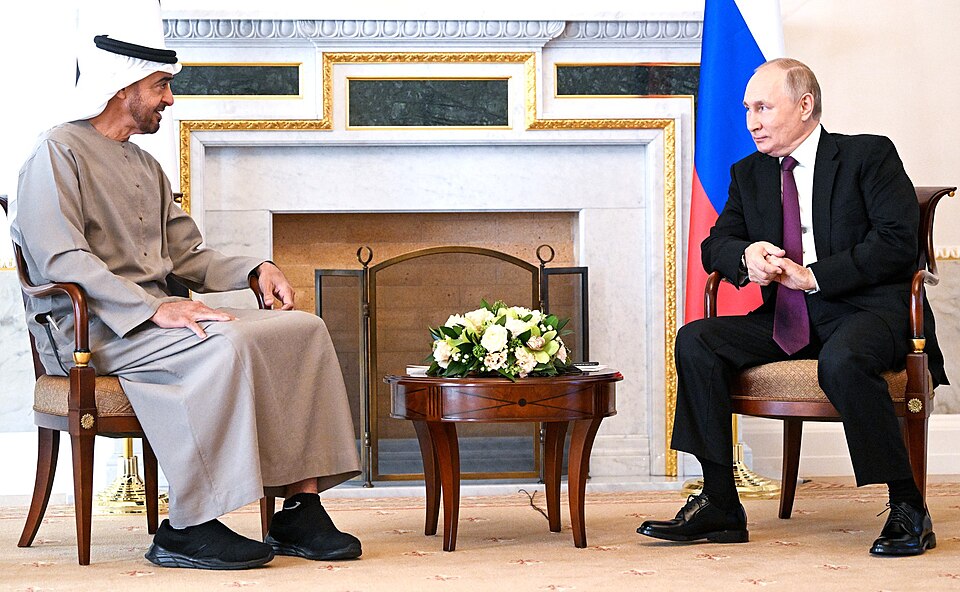
UAE President Mohammed bin Zayed meeting with Putin In a similar fashion to Russia, Israel’s war in Gaza has turned international opinion against it. Public support for Israel in Western countries has been continually eroded by Israel’s conduct of the war. Jerusalem has even been brought on a collision course with Washington over the conflict in Gaza. Israeli defense contractors like Elbit Systems have even been barred from participating in international arms expos. During the Cold War and even today, Israel has provided and still provides military aid to states in the Global South with less-than-stellar human rights records. In Latin America, the Israelis armed Argentina’s brutal military junta, the Somoza dictatorship in Nicaragua, and the bloodthirsty military regimes in El Salvador, just to name a few places. Israel also aided the apartheid regime in South Africa and the white minority government in Rhodesia (both of which were isolated themselves).*
Jerusalem and Moscow both claim to be waging defensive wars out of necessity, but both wars have actually damaged their image and undermined their security. In the case of the former, Hamas and Hezbollah pose an existential threat. In the case of the latter, NATO expansion is a direct encroachment on Russia itself. Israel and Russia place a heavy emphasis on hard power within their foreign policy strategies. Both Russia and Israel have had to look far and wide for friends in the international arena. If need be, both countries are willing to rub shoulders with oppressive, undemocratic states in the Global South, but for different reasons.
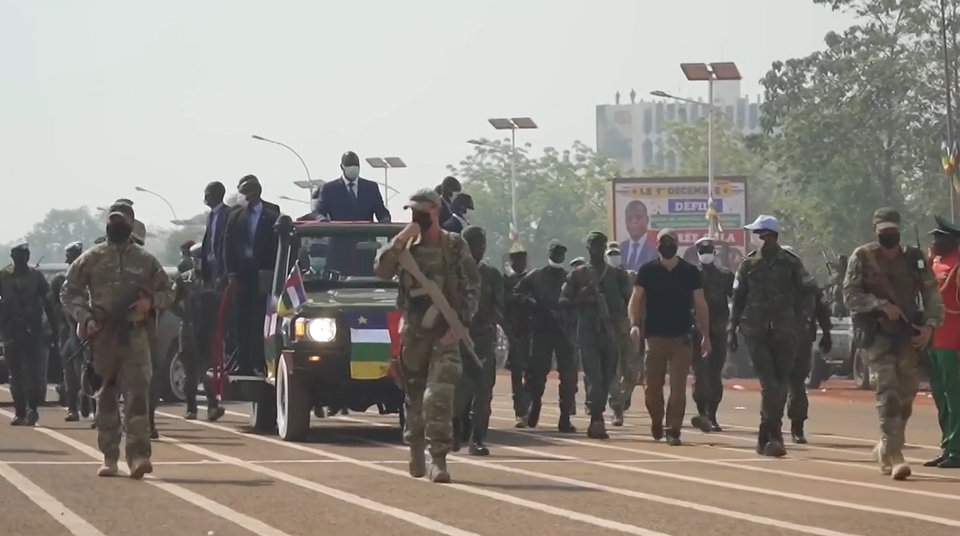
Russian PMCs performing security duties in the Central African Republic Jerusalem and Moscow’s differences
There are notable differences between Moscow and Jerusalem’s foreign policy strategies, as well. Israel has the support of the United States and most of its allies, despite their condemnations of Israeli actions in Gaza. At the UN, the United States shields Israel from more substantive action being taken against it by the international community. There are no international sanctions against Israel. Israeli citizens are still permitted to travel to the EU and the United States. Israel is still well-integrated within the global economic and financial system. Israeli high-tech firms still maintain a significant global market share. EU member states like Germany and Romania, as well as countries like South Korea and India, have either purchased or expressed interest in purchasing Israeli arms. In contrast to Russia, Jerusalem is an integral part of the American-led international order, being an OECD member state and a member of the Paris Club. Israel is insulated from the consequences of economic and political isolation in ways that Russia is not.
Moscow, on the other hand, must recreate its own global network from scratch. Russia has almost no friends in the West. Since 2022, Russia has grown even closer to other pariah states like Iran and North Korea. Unlike Israel, Russia does not have a booming tech sector. Russia also has no access to Western technology. The Russian economy is still heavily dependent upon oil and gas revenues. Russia’s “alliances” with China, Iran, and North Korea are little more than surface deep. These states are united only by a desire to counter American global hegemony; even then, this convergence is tenuous. There is no Russian-led NATO, no matter how much the CSTO and SCO want to play the part. There is no Russian-led equivalent of the IMF or World Bank. Simply put, Moscow does not carry as much clout as the United States and its allies.
Straddling East and West
Interestingly enough, there is another commonality between Jerusalem and Moscow. Russia and Israel sit between the West and East culturally and geopolitically. Israel is the sole “Western-style” democracy in the Middle East, and its politics is still Ashkenazi-centric. Still, Israel can maintain warm relations with non-Western states like Azerbaijan and India, despite its pro-Western alignment. Russia, on the other hand, is a majority-Christian country with Slavic and Norse roots, but is still estranged from the West. The “East/West” limbo that these countries occupy presents opportunities and challenges. Russia is able to use its Eurasian heritage and anti-Western geopolitical alignment to win greater cachet in the Global South. This means, though, that Moscow is aligning itself with other pariah states. Israel can cash in on its status as a beneficiary of Western support and can provide military/economic aid to countries in the Global South without the lectures on democracy and human rights that come with Western aid. Israel’s “in-between” identity gives Jerusalem flexibility, but Russia’s only isolates Moscow.
Conclusion
The Russian Federation and the state of Israel both see themselves as fortresses under siege. Both place a greater reliance on armed force to achieve their strategic goals compared to other states. They both occupy the crossroads between the East and the West. However, Israel’s integration within the US-led world order has given it political and economic lifelines that Russia can no longer benefit from. Both Moscow and Jerusalem are discovering that self-reliance in such an interconnected world has its limits. The future stability of Eurasia and the Middle East may not be solely dependent upon how these countries fight their wars, but also how they make and keep their friends.
*Source: The Israeli Connection: Who Israel Arms and Why by Benjamin Beit-Hallahmi (PURCHASE IT HERE: https://amzn.to/42QiNEm).
 From Galilee to the Gulf